Shop Floor Board: Structure, KPIs and Daily SQCDP Meeting
What a shop floor board is, how it is structured and how the daily SQCDP meeting is run – KPIs, design and practice.
10.06.2026
·
9 min read
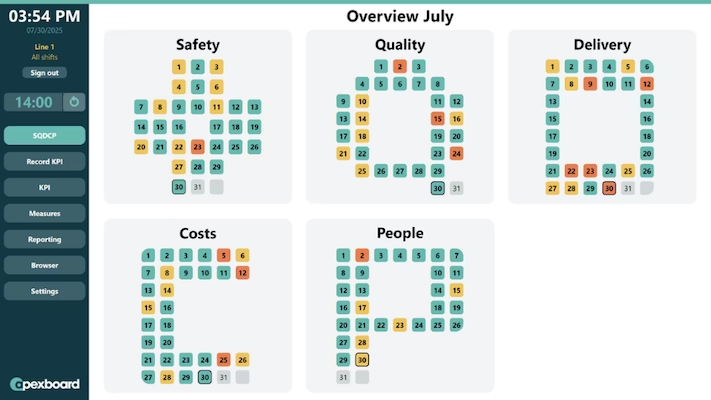
- A shop floor meeting is the short, daily alignment right in production – ideally at a digital SQCDP board.
- SQCDP stands for Safety, Quality, Cost, Delivery and People – the five dimensions the board is structured around.
- A good daily huddle lasts 10–15 minutes and follows a fixed agenda.
- Peakboard's Apexboard fills the board with real-time data instead of maintaining it by hand.
A shop floor board makes the current state of production visible at a glance: KPIs on safety, quality, cost, delivery and people (SQCDP) are visualised and discussed in the daily shop floor meeting. Peakboard fills the board automatically with real-time data from machines and ERP – no whiteboard that nobody maintains, no action that quietly disappears.
What is a shop floor board?
A shop floor board (also called a shop floor management board) is a physical or digital display at which the team discusses the daily production status. It shows KPIs across five dimensions – Safety, Quality, Cost, Delivery and People (SQCDP) – and makes deviations immediately visible. The board is the centrepiece of the daily shop floor meeting.
Shop floor board structure: what belongs on it?
An effective shop floor board is clearly structured. The proven layout follows the five SQCDP dimensions:
- S – Safety: e.g. days without an accident, open safety reports
- Q – Quality: e.g. scrap rate, first-pass yield
- C – Cost: e.g. productivity, OEE, actual vs. target output
- D – Delivery: e.g. on-time delivery in %, open orders
- P – People: e.g. attendance, skills matrix
Each KPI gets a target value and a traffic light – green, amber, red. The team sees at a glance where immediate action is needed.
How do I design a shop floor board?
When designing, less is more. Five to seven KPIs are enough – too many metrics lose focus. Three ground rules:
- Only KPIs that lead to an action. Whoever sees the number should know what to do.
- Target value always visible. Without a target there is no deviation – the traffic light needs a reference point.
- Real time, not yesterday. A board with stale numbers loses the team’s trust.
Analogue boards are filled in by hand – that costs time every day and leads to outdated data. The Apexboard from Peakboard pulls KPIs automatically from machines, SAP and ERP, keeping the board current without manual effort.
Shop floor board examples from practice
Two typical use cases show what a digital shop floor board looks like in practice:
- Series production: The board shows shift OEE, scrap rate and line attendance in real time. When thresholds are breached, it automatically triggers an escalation via the Andon board.
- Assembly: Order progress from SAP, quality reports from the QM system and changeover times all come together on a single display – the shift supervisor sees the status of all lines without having to ask.
What is an SQCDP meeting?
The SQCDP meeting (also daily huddle or shop floor meeting) is the daily review at the board – short, standing and solution-focused. The team discusses deviations from the previous day, derives actions and assigns ownership.
How does a daily huddle run?
A good daily huddle lasts 10 to 15 minutes and follows a fixed agenda: safety first, then the KPIs per SQCDP dimension, deviations from the previous day, open actions and new to-dos with clear ownership. Discipline matters: short, standing, solution-oriented.
Capturing actions directly at the board
The board shows what went wrong. The decisive question is: what happens next? The Apexboard solves this with an integrated continuous improvement board. Actions are captured directly on the touchscreen: title, owner, due date, priority. Every open action stays visible until it is closed – no sticky note, no email chain.
Shop floor management board: digital vs. analogue
Classic whiteboards have to be maintained by hand and are rarely up to date. A digital shop floor board pulls data automatically from machines and ERP, escalates threshold breaches via an Andon board and documents actions in an audit-proof way. The shop floor board is a central building block of shop floor management. The step-by-step rollout guide is 10 steps to digital shop floor management. The tool to make it happen is Peakboard’s shop floor management software.
Solution
Apexboard – the digital shop floor board
Fill the SQCDP board with real-time data and run the daily huddle digitally.

What does SQCDP mean?
SQCDP stands for Safety, Quality, Cost, Delivery and People – the five dimensions a shop floor board is structured around.
How long does a daily huddle take?
A daily huddle usually lasts 10 to 15 minutes and follows a fixed agenda along the SQCDP dimensions.
What is the difference between an analogue and a digital shop floor board?
An analogue board is maintained by hand; a digital board like the Apexboard is filled automatically with real-time data from machines and ERP.