Digital Andon Board: Real-Time Visibility on the Shop Floor
What is a digital Andon board, how does it work, and what benefits does it bring to production? A practical guide with examples and a 5-step rollout.
01.06.2026
·
6 min read
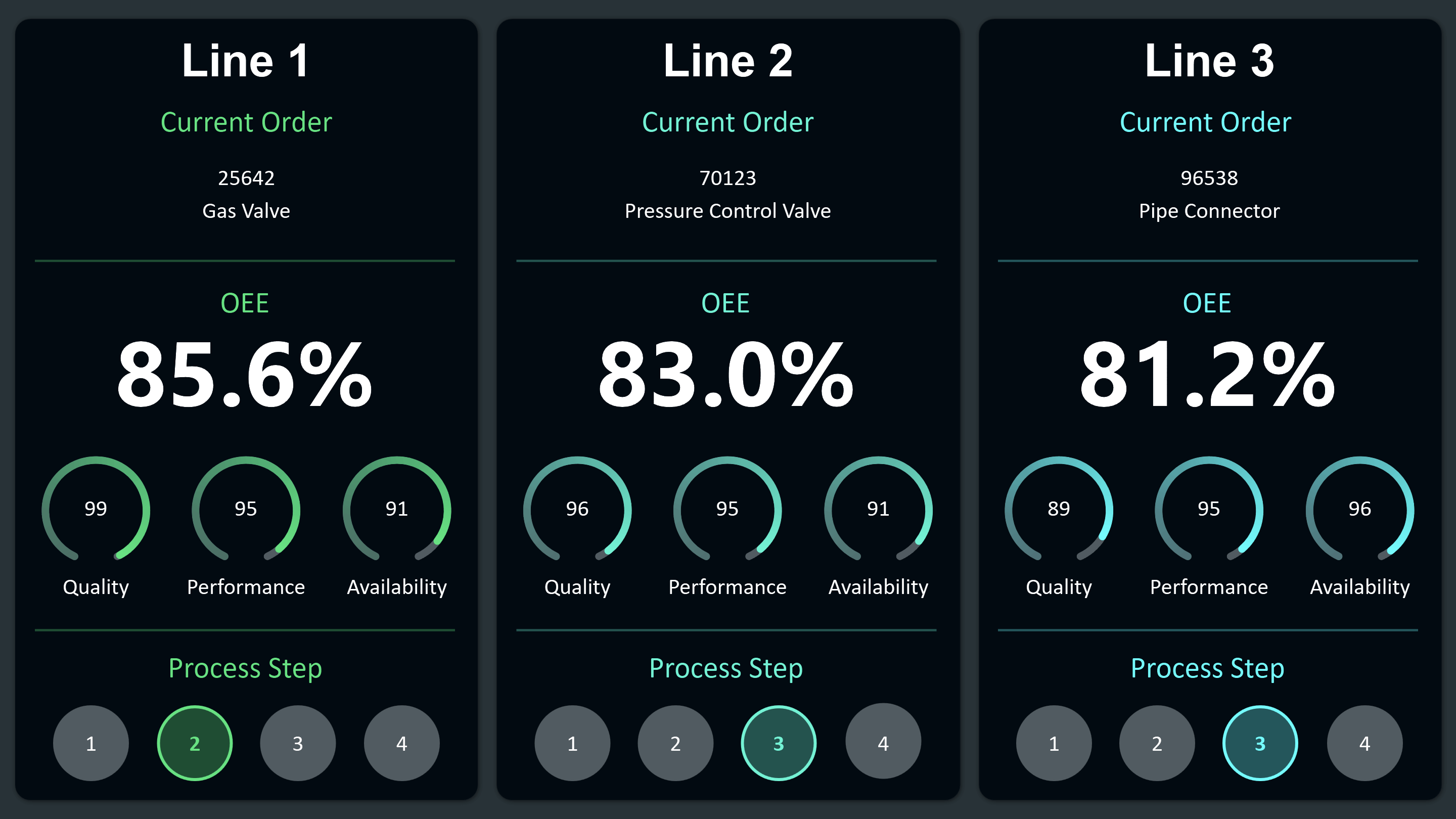
- A digital Andon board visualizes machine and process status in real time.
- It replaces the classic Andon light with dynamic dashboards connected to any data source.
- Typical sources: PLCs, OPC UA, MQTT, databases and ERP systems such as SAP.
- Benefits: faster response times, less downtime, and more visibility on the shop floor.
A machine grinds to a halt – and on a busy shop floor, no one notices for minutes. A digital Andon board closes exactly this gap: it makes the state of production visible in real time and automatically alerts the right people before a brief fault turns into a costly stoppage.
What is a digital Andon board?
A digital Andon board is a software-based display that shows production status, output quantities, cycle times, and faults in real time. The term “Andon” originates from the Toyota Production System and refers to a visual signaling system that immediately makes operators aware of problems in the process. While the classic version is a simple traffic light in red, yellow, and green, the digital version can be linked to any machine data and KPIs.
This turns the Andon board from a mere warning light into a central building block of digital shop floor management: it bundles information that would otherwise be scattered across individual machines and systems.
How does a digital Andon board work?
Connecting data sources
A digital Andon board is only as good as its data. Through interfaces such as PLC, OPC UA, MQTT, or direct database and ERP connections, machine states, quantities, and cycle times flow onto the board in real time. The article From sensor to actuator shows how a simple sensor signal becomes usable information.
Signaling and escalation
As soon as a defined threshold is breached – for example a machine stop or output falling below target – the board changes status and triggers an escalation. This can be a color change, a message on a large screen, or a notification to maintenance and shift management. Passive display becomes active shop floor communication.
Classic vs. digital Andon board
The classic Andon light signals only one state and must be triggered manually. A digital Andon board captures states automatically, combines several KPIs, stores the history for analysis, and can be adapted without changing hardware. That makes it a central tool of visual operator management.
Benefits for production and maintenance
- Faster response times: faults become visible instantly instead of being noticed on the next round.
- Less downtime: faster escalation measurably reduces unplanned stoppages.
- More visibility: everyone sees the same status – from operator to plant management.
- Data-driven improvement: the stored history reveals recurring bottlenecks and provides the basis for continuous optimization.
A digital Andon board in 5 steps
- Define the relevant KPIs and fault cases.
- Identify and connect data sources (PLC, OPC UA, MQTT, ERP).
- Set thresholds and escalation logic.
- Design the display for the shop floor and end devices.
- Start a pilot, gather feedback, and roll out.
For the bigger picture, the guide 10 steps to digital shop floor management sets out the overall strategy. Background on the origin is provided by the description of Andon in the Toyota Production System.
Free template
Try the Andon board template right away
Transform live data into smart decisions – with Peakboard.

Frequently asked questions about the digital Andon board
What does “Andon” mean?
“Andon” is a Japanese term for a signal light from the Toyota Production System – a visual system that makes problems in the process immediately visible.
Which data sources can a digital Andon board use?
Typical sources are PLC controllers, OPC UA, MQTT, databases, and ERP systems. They feed machine states, cycle times, and quantities straight onto the board.
How much does a digital Andon board cost?
The cost depends on the number of machines, data sources, and displays. The decisive factors for ROI are reduced downtime and faster response.
Do I need new hardware?
In many cases, no. A digital Andon board uses existing controllers and displays and connects via software.