
How SCHOLZ centrally provides priorities, shift information, and production data with Peakboard

Scholz GmbH + Co. KG
challenges
Consistent visualisation of prioritisation logic across various departments
solution
12 Peakboard boxes on 65-inch touch displays (Production, Packaging, QA, Assembly, Welcome Boards) with connection to Business Central and SQL; and central management via the Peakboard Hub
benefits
- quick implementation and easy expandability
- flexible connectivity for additional data sources
- central and clearly structured information provision directly at the workstation
- consistent information level for all involved areas
- less coordination effort through central visualisation of relevant information
Time to Value
Four weeks from hardware purchase to productive use
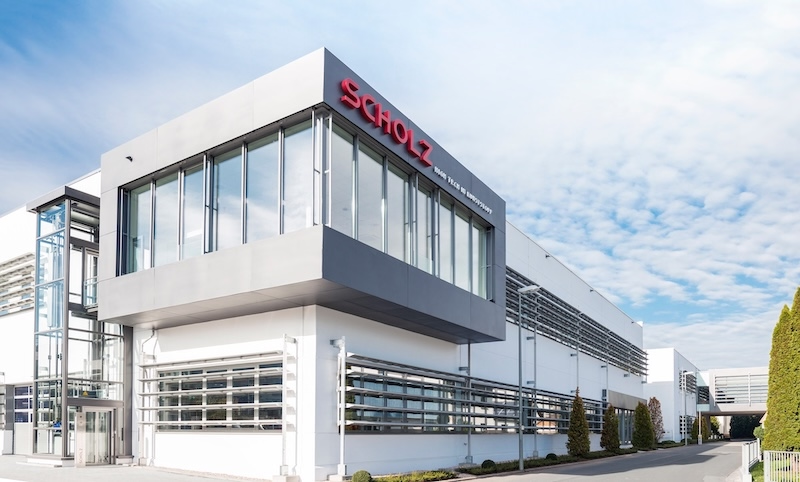
Scholz GmbH & Co. KG has stood for high-tech plastics since the 1970s. Its service portfolio includes high-precision solutions in the fields of technical precision parts, gearing technology, microtechnology, and medical technology. Based in Kronach and with a team of over 200 employees, the family-owned company manufactures technical plastic parts for the automotive industry, consumer goods, medical technology, and electronics.
Peakboard makes complex data easily accessible for us. The solution is intuitive, works very well with touchscreens, and helps us keep a clear overview of priorities in our daily work.
Making production-relevant information from the ERP system available across departments
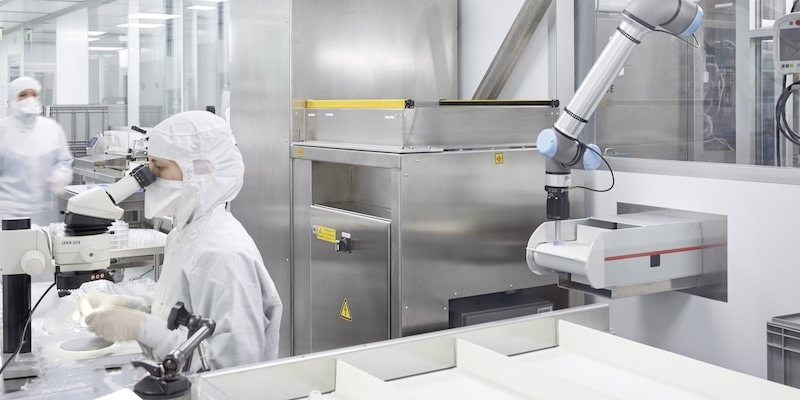
Production takes place in a demanding manufacturing environment with various production areas across three spatially separated manufacturing complexes, including clean and sterile room areas. This makes it all the more crucial that all involved departments can access the same information at all times. In addition to the processing order, this also includes shift information, notes for the next shift, and energy and compressed air consumption.
To ensure employees in production, packaging, assembly, and quality assurance always know what has priority, the company uses a ranking system in its ERP system, Business Central. This ranking indicates for items and batches what needs to be processed first. It is based on a score calculated from parameters such as delivery dates, warehouse lead times, and specific product-related requirements. This is particularly important for sensitive parts that must be quickly processed and packaged after manufacturing to minimise the risk of contamination.
Previously, this information was only retrieved for individual departments within the ERP system and then shared via email, phone, or verbally.
“In our business environment, characterised by complex articles, diverse customer requirements, and quality-critical processes, it was no longer sufficient for us to merely store data somewhere in the system,” explains Robin Peter, ERP/ECM Administrator and Programmer at SCHOLZ GmbH + Co. KG. “What's crucial is that the information reaches where concrete decisions are made, from manufacturing and packaging to quality assurance.”
An additional practical problem arose, adds Anna-Lena Scharf, working student in Data Analysis at SCHOLZ GmbH + Co. KG:
“Information shared verbally or via email doesn't always reach everyone at the same time. If an email sent to a shift group is read by one person, it no longer appears as a new email in the list and is therefore easily overlooked.”
The objective was therefore to provide all involved departments with uniform and direct access to this information, without detours via email, phone, or ERP screens.
Peakboard impresses with its low-code approach and user-friendliness
For Anna-Lena Scharf, the project began with a clear list of requirements. They were looking for a solution that could be implemented quickly and easily, used by employees without deep IT knowledge, and flexibly connected to various data sources and visualisation requirements. The search was conducted via internet research and an AI benchmark. Four solutions made it onto the shortlist, including established BI platforms.
From the outset, it was important for SCHOLZ not to wait months for initial results. One provider had therefore withdrawn early from consideration. It was indicated that, in principle, the desired solution could be implemented, but it would take until summer before anything could even be displayed. That was not an option for SCHOLZ.
“We didn't want to invest time just making visualisations feasible; we wanted to get started quickly,” confirms Anna-Lena Scharf.
Peakboard impressed with precisely this rapid implementability. The software is based on a low-code approach, meaning no programming is required. Visual building blocks are available for more complex use cases. Furthermore, the intuitive usability and the ability to connect various data sources were decisive. Additionally, the licensing and technical implementation perfectly matched SCHOLZ's requirements. According to Anna-Lena Scharf, the personal consulting also proved convincing.
“Peakboard was very open about it. If we needed support, it was clear we would get it. And we also had a good rapport.”
Kick-off Workshop + Bring-your-own-Device Test Phase
SCHOLZ started the project with a customised Peakboard workshop, which not only provided an introduction to the software but also involved jointly setting up the specific application and directly experiencing Peakboard's functionality in practice. For Anna-Lena Scharf, this was a conscious decision:
“While Peakboard is very intuitive, and we could have started building immediately. But it was important for us to set up the solution correctly from the start, fully understand how it works, and also pick up the little tricks. The in-house workshop proved to be exactly right for that.”
Practical implementation began after requirements engineering in a Bring-your-own-Device phase. For this, SCHOLZ used the free Peakboard Designer to create initial visualisations, which were tested as part of a Proof of Concept. The focus was on key figures for packaging from the ERP system, including a to-do list showing which item with which batch should be processed first.
Four weeks from hardware purchase to productive use
After the successful Proof of Concept, the company ordered the first six Peakboard boxes and began the productive roll-out.
“For packaging, it took about a month from hardware provision to the running application,” recalls Anna-Lena Scharf.
Further applications were developed incrementally. The Peakboard boxes are managed via the Peakboard Hub. Relevant data from the Business Central ERP system and SQL databases is centrally stored and managed in Peakboard Data Hub lists. Updates occur, on average, every 60 seconds. The data is visualised on 65-inch touch displays.
“We were able to implement around 90 percent of the development and adjustments ourselves. We only needed support with password protection for one application,” says Anna-Lena Scharf. “The Peakboard team implemented that for us within about a week and a half.”
12 Peakboards for Production, Packaging, Assembly, Quality Assurance, and Employee Information
Today, SCHOLZ has a total of about twelve Peakboard boxes in use across various departments.
In production, packaging, assembly, and quality assurance, prioritised to-do lists are central, showing which items need to be processed with what priority. These are supplemented by shift schedules, employee information, and department-specific information on parts from the start-up process that are expected next, or energy and compressed air consumption. The content is not rigidly arranged on a single page but is interactively structured. Starting from an initial overview of all key figures, detailed views that employees need for their work can be specifically accessed.
Welcome Boards are displayed at the entrances, showing important daily or weekly information, such as business appointments or in-house events.
Clear Understanding of Priorities
The greatest benefit for SCHOLZ is that relevant information is now available faster and uniformly for everyone.
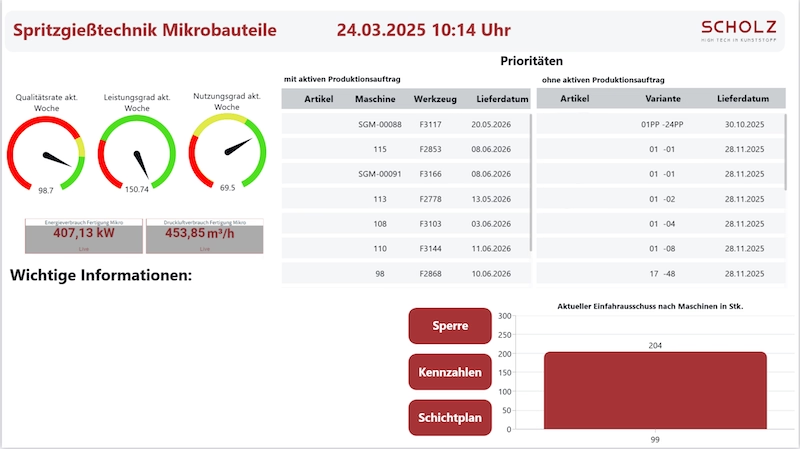
“Important information and prioritised items are no longer scattered, delayed, or known only to individuals; instead, they are centrally available to everyone. This ensures that everyone in their respective shift department has the same information at the same time,” summarises Anna-Lena Scharf. “Because the prioritised logic, in the form of to-do lists, now extends across multiple departments, urgent items are consistently given preferential treatment,” adds Robin Peter.
The new solution was well-received by employees; however, the Peakboards first had to earn the trust of the workforce, recalls Anna-Lena Scharf:
“Initially, there was some scepticism about whether the visualised information was truly accurate. But after comparing the key figures with the results from their previous direct queries of the ERP system, they were able to convince themselves that the sequences and information were consistent.”
Employees now naturally use the boards in their daily work.
Peakboard also plays a special role for Anna-Lena Scharf herself. As a business informatics student, digitalisation was always a familiar topic to her, but technical implementation had not been among her favourite subjects until now. That changed with her work on Peakboard. Thanks to Peakboard's low-code approach, she was able to implement her own applications without traditional programming and directly see them become concrete solutions for daily work.
“Thanks to Peakboard, designing digital applications has become part of my daily work, and I've really come to enjoy it,” concludes Anna-Lena Scharf.
Peakboard Expansion Planned
SCHOLZ intends to more precisely evaluate the specific quantitative effects resulting from the use of Peakboards after a longer application phase.
However, it is already clear that the application landscape will be further expanded in the future.
“We don't just want to display everything that's possible, but rather be guided by the ideas and actual information needs of employees to specifically enhance the improved overview,” explains Robin Peter.
Peakboard offers the necessary flexibility to effortlessly connect additional data sources and develop new applications.
Start now with Peakboard and simplify your processes
Turn live data into smart decisions with Peakboard.
