Here's how it works: employee motivation through OKR dashboards
Employees who enjoy their work and are motivated to contribute to the success of the company are the dream of every company management. But how do you create the necessary incentives to keep the workforce motivated?
10.04.2024
·
4 min read

- OKR stands for Objectives and Key Results – goals plus measurable outcomes.
- An OKR dashboard makes goals and progress transparent for everyone.
- Transparency about goals boosts focus, ownership and motivation.
- OKRs are the opposite of a to-do list: they measure impact, not activity.
Clear goals and transparency: the key to focused and motivated work
A decisive factor is the interplay of awareness and responsibility for one's own goals. What sounds banal at first is ignored in many companies: most employees, from operators to IT managers, are exposed — not least thanks to modern means of communication — to a constant flood of tasks that are hard to survey and sensibly prioritize.
For focused and therefore motivating work, employees often lack two crucial pieces of information:
- What is my goal with my current task?
- What progress is achieved as a result?
One way to address this problem is to create constant transparency on precisely these questions. Generally accessible dashboards on which so-called OKRs are defined help: Objectives and Key Results.
What does OKR actually stand for?
The abbreviation OKR stands for “Objectives and Key Results.”
The “objective” is a qualitative goal that an entire company or department defines for itself. This could be, for example, an increase in performance in a specific area of activity. The significance of the goal must be clear to everyone involved, but it should not be directly measurable. The key results, in contrast, are concrete and measurable. Three key results are assigned to each objective. They clearly define the criteria for achieving the goal and can be based on anything measurable: growth, revenue, participation, or performance, for example.
Agile management through the OKR method
OKR is an agile management method that has been driving many of the American big players for years and is now attracting more and more attention in Germany as well. Many advocates even see it as a cornerstone of the continued success of Google, Intel, and others.
The core idea is to make better use of the potential employees bring to their work: if they are well informed about the current goals and how to achieve them, every work step gains greater importance. Jointly agreed goals also provide the focus that is necessary in the face of a constant flood of tasks. This focus away from non-goals and irrelevant tasks relieves pressure and significantly reduces distracting stressors.
Example and implementation of an OKR dashboard
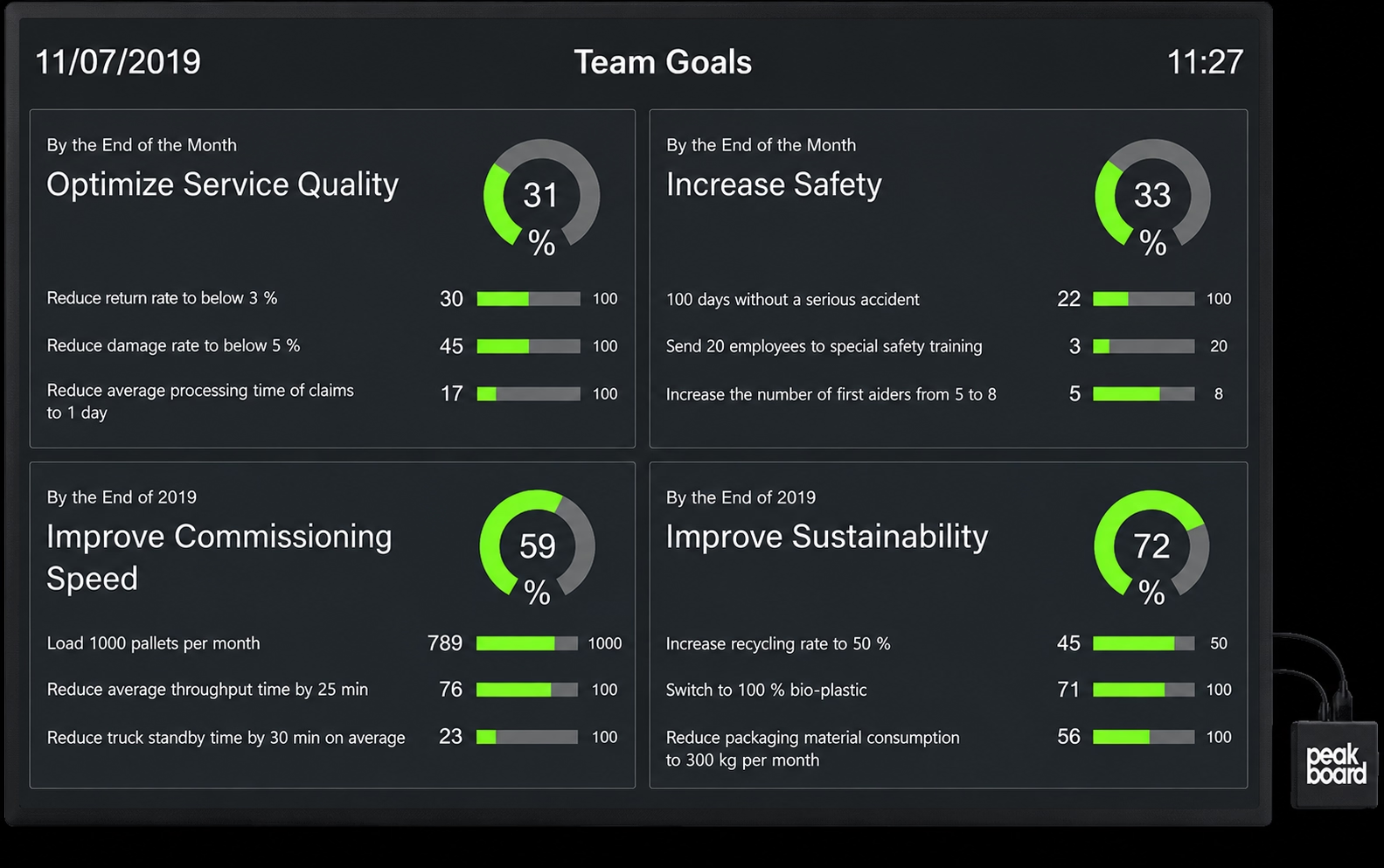
Our template shows schematically how a good OKR dashboard works. It first outlines the objectives, then lists the associated key results and documents the current progress per key result, which is aggregated into an overall progress figure. Objectives must be defined for a fixed time frame so that they are recorded as a clear goal — as the example shows, the deadlines can also vary between objectives. The associated key results should be chosen ambitiously, so not too easy to achieve. They should, however, stay within reach so as not to demotivate. The theory is that key results should be achieved at a level of around 60–80 percent by the end of the period in order to achieve maximum motivation.
OKRs — the opposite of a to-do list
There are common mistakes that can make OKRs fail. Avoid setting too many or too finely divided OKRs: that quickly brings back the old problem of many unimportant tasks and loses the necessary focus. It is also inadvisable to include specific instructions for action in the key results. The method then loses its character of giving the team more personal responsibility and motivation, and the OKRs quickly turn into an old-fashioned to-do list again.
Refrain from linking pay to OKRs as well. Especially when adjustments are made along the way, this means the actual goal — developing meaning, progress, and success in one's own work — is lost. Instead, OKRs should be defined so that employees have a strong commitment to achieving performance improvements. That may then be the reason for a salary increase in the medium or long term.
Focus, motivation and efficiency through OKRs
Once a team has set an OKR, the formulated goals should not disappear into a drawer, only to be checked at the end of the defined time frame. The key results should be reviewed in regular feedback meetings: the team members jointly analyze where they stand against their goals, what actual progress or lack of progress can be attributed to, and what may need adjusting. Involving all employees in strategic tasks also sends a signal of appreciation and trust, which acts as a further motivating factor. This combination of fixed goals and self-organized work steps is what makes OKRs agile.
Motivation through a modern communication culture
The last decisive aspect of successful OKRs is communicating the goals clearly to the entire workforce — ideally digitally, right in the warehouse or in production — and presenting progress publicly. That includes making all relevant progress information available on the OKR dashboard at all times and in real time.
This creates public awareness of the company's progress and gives employees a sense of the effectiveness of their own work and of the team's overall progress. It provides everyone with a basis for discussion, both informally about the company's goals and for contributing meaningfully to the feedback meetings. The associated communication culture increases the potential of the entire workforce and enables every industry, company size, and department to achieve more with the resources available across all value-adding processes.
Frequently asked questions about OKR dashboards
What does OKR stand for?
OKR stands for “Objectives and Key Results” – a goal (Objective) is backed by measurable key results that show progress.
What does an OKR dashboard achieve?
It makes goals and progress visible to the whole team. That transparency fosters focus, ownership and motivation.
How is OKR different from a to-do list?
A to-do list collects tasks; OKRs measure the outcome. It is about impact, not ticked-off activities.