
How Hightech-Electronic uses Peakboard to run the shop floor with greater transparency

Hightech-Electronic GmbH
challenges
Capture production data systematically, support cycle timing, reduce paper-based processes and make deviations on the shop floor visible sooner
solution
Peakboard as a low-code platform for a digital work and feedback interface at around 30 workstations in production, complemented by a central 75-inch monitor in the production hall and overviews in the supervisor's office
benefits
- around 10 percent additional efficiency
- a direct feedback channel from the workstation into production control
- clear orientation on target quantity, actual quantity and remaining time
- more transparency on cycle, unit counts, confirmations and interruptions
- better analysis of downtimes and process problems
- a consistent interface across different workstations
Time to Value
After a trial installation, an initial implementation with Peakboard support and around three months of productive use in production, the feedback data is reliable and efficiency has improved by around ten percent.
Hightech-Electronic manufactures electronic assemblies and devices in Geldersheim, from prototype to series production. Its portfolio covers device manufacturing, assembly, printed circuit board assembly and programming. Around 30 employees work there in a production environment where many steps are carried out manually and a stable cycle is decisive.
When Klaus Bauer took over the company as part of a succession plan, he quickly saw that there was still considerable digitalization potential in production and in the organization. The most pressing question was a very practical one: which data and feedback does production need directly at the workstation so that day-to-day work runs better?
When material, a tool or a preliminary product is missing, that is not an individual performance problem but a process problem. With Peakboard we can see at every station where time is lost and why. In the past, such issues were spotted at best in random samples, and often only once the damage was done.
From “breathing production” to reliable production data
Around 30 employees work across roughly 2,800 square meters of production space at Hightech-Electronic. The main production line is balanced. Every station has defined work content and target times, and the line is meant to run as evenly as possible. Shop floor management was largely based on paper checklists, visual inspections and experience. What worked in day-to-day operations was only of limited use for analysis and control.
Klaus Bauer describes what he found as “breathing production”:
“When extremely high volumes were required, things happened that you would think impossible. My colleagues effectively ran a marathon at sprint pace. When the pressure eased, the rhythm settled again, but not necessarily evenly.”
What was missing was a reliable view of where the line currently stood. Downtimes were recorded at best in random samples, without a longer time context and without a clear attribution of causes. Whether material was missing, a tool was not available or a machine had failed could often barely be reconstructed afterwards.
Because a large part of production at Hightech-Electronic is manual, an even production flow is an important competitive factor.
“Manual work in Germany is always under particular efficiency pressure,” says Klaus Bauer. “That is why we have to function well as an overall system. Employees should be able to see whether they are on schedule. And we need to recognize where time is lost, because material is missing, a tool is not available or a process is not running cleanly.”
So this was not about monitoring employees more closely. What mattered was recognizing earlier where the cycle falls out of rhythm, and why.
The solution was also not meant to remain limited to the main line. Hightech-Electronic was looking for a platform that could bring data from different systems directly to the workstation and later be used in other areas and companies within the group.
One interface for the shop floor
Even before taking over Hightech-Electronic, Klaus Bauer had looked into solutions for shop floor visualization and digital production support. In his view, many approaches were too technical for everyday use in a mid-sized company.
“You always needed a programmer,” says Bauer. “That makes such projects expensive and slow. In the mid-market in particular, a solution has to be feasible alongside day-to-day business, without a major IT project.”
For Hightech-Electronic this was not about yet another isolated dashboard, but about an application directly on the shop floor: data from Microsoft Dynamics 365 Business Central, digital production information and feedback from the line were to come together in one shared interface. Peakboard thus became the link between production control and the workstation.
Peakboard fit these requirements because the low-code platform makes it possible to set up, adapt and extend industrial applications without conventional programming. Ready-made templates reduced the initial effort and at the same time showed what can be built with Peakboard. For Hightech-Electronic that was an important point, as digitalization has to run alongside day-to-day business.
“On top of that there were the available Peakboard templates,” Bauer adds. “They reduced the effort of getting started and at the same time showed everything that is possible with Peakboard. For us they were also a pool of ideas.”
From the outset it was clear that Peakboard would not stop at the main line. Further areas were to follow step by step.
From template to an application on the line
Hightech-Electronic started with a free trial installation. In the first phase, Klaus Bauer drove the project himself. As in many smaller companies, that initially happened alongside day-to-day business. The start-up phase therefore took longer than planned. The project gained pace when working students and a young engineer took the topic on more actively.
From a first Peakboard template, the first application for balancing the main production line was built together with a Peakboard consultant. The template used was Overview and Control for Single-Station Production. At Hightech-Electronic's request, much of the coordination took place remotely via Microsoft Teams. Production was even shown by camera so that the Peakboard consultant could follow the situation on the line.
For the first application, Hightech-Electronic deliberately brought in support from Peakboard. Bauer sees this above all as a head start: anyone who has not yet built up their own expertise gets to implementation faster with a Peakboard consultant, without it turning into a large IT project.
“My recommendation: bring in a consultant for the start. Then the project picks up speed and you build up your own expertise at the same time.”
The low-code approach was relevant above all because the solution was not meant to be created as a conventional IT project. Working with Peakboard, an existing template became an application for the main line that Hightech-Electronic can now develop further itself. Layout, data and logic can therefore be adapted closer to the department, while IT mainly secures infrastructure and connectivity.
Peakboard is currently in use at around 30 workstations in production. At each station, employees see the target quantity for the current cycle, the actual quantity already confirmed and the remaining time on a 24-inch screen. Shortly before time runs out, the monitor starts to flash. Once a work step is complete, it is confirmed directly on the touchscreen. The next cycle then starts.
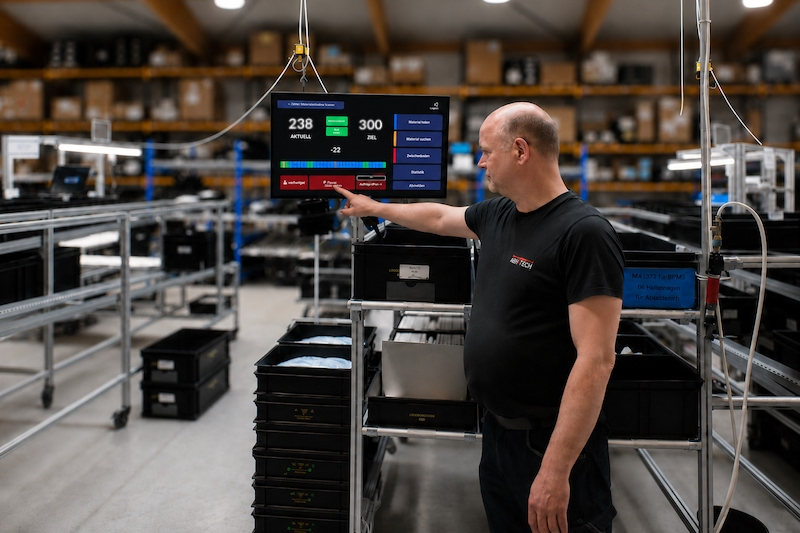
“Operation is very simple for our employees,” says Bauer. “They do not have to use several applications; they see on one screen where they stand and confirm the next step there as well.”
In addition, a central monitor in the production hall provides an overview. The relevant information is also visible in the supervisor's office. Production instructions are now available digitally at the workstations as well.
Peakboard pulls the data from Microsoft Dynamics 365 Business Central; on top of that come the confirmations employees make at the stations. This creates a direct feedback channel from the workstation into production control.
Around ten percent additional efficiency and more transparency on the shop floor
After around three months of productive use in production, Hightech-Electronic is seeing the first solid effects. The feedback data has stabilized, especially in recent weeks. Employees have a better view of the cycle, can report their progress directly, and deviations become visible immediately.
For Hightech-Electronic, the most important effect lies not in visualization alone, but in the closed information loop: production sees at the workstation where it stands in the cycle, and production control receives structured feedback from the line. Deviations therefore do not only become visible afterwards, but while they are happening.
For Bauer it is at least as important that it becomes visible why things are stalling.
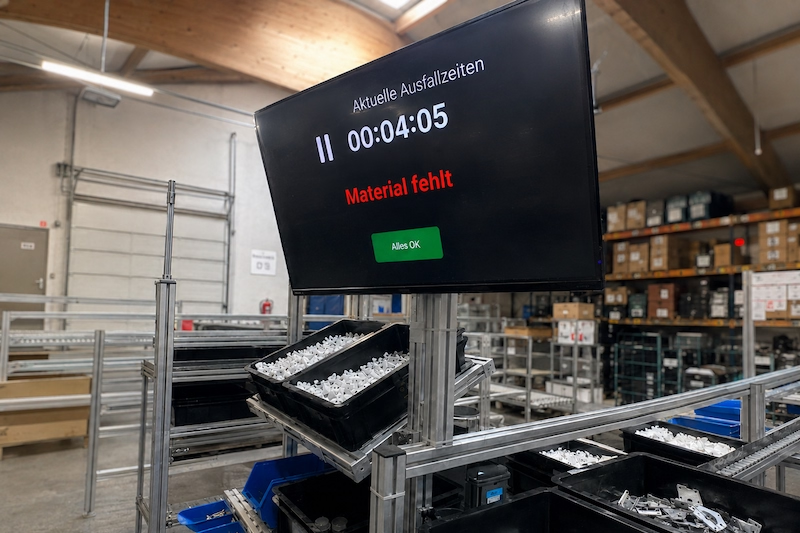
“When material, a tool or a preliminary product is missing, that is not an individual performance problem but a process problem. With Peakboard we can see at every station where time is lost and why. In the past, such issues were spotted at best in random samples, and often only once the damage was done.”
Bauer stresses that this is not about replacing experience. Committed employees had done many things right before as well. But Peakboard brings that knowledge across the shop floor more reliably and makes it usable as real-time data at the workstation. Together with the MTM target times, a clearer picture is emerging today of what actually happens in production. Managers can analyze deviations without relying on assumptions. Bauer assumes that this has enabled an additional efficiency contribution of around ten percent.
He warns, however, against confusing transparency with a desire to intervene. More data does not mean that management has to steer everything itself.
“Just because I see more as a managing director today does not mean I have to intervene everywhere myself,” he says. “What matters is that the people responsible work with the data, understand causes and derive the right measures from them.”
The same applies to the design of the interfaces. Here too, Bauer argues for concentrating on the essentials.
“Not every piece of information that is theoretically available helps at the workstation,” he says. “There is no point in putting 20 buttons or the tenth report on the screen. At the workstation it has to be immediately clear what matters. That is why you have to keep asking: which information is actually used? What genuinely helps? And what can be left out?”
Roadmap for production, kanban, workforce and production planning
For Hightech-Electronic, the application on the main line is only the beginning. Next on the list are kanban racks, staff allocation, retrospective data entry and detailed planning, among other things.
Target times and target quantities are already recorded in pre-assembly. Going forward, the kanban racks are to be integrated more closely as well. It will then be quicker to see where material needs to be replenished.
“For us it is not at all clear yet where things will end with Peakboard,” says Bauer. “We want to expand the solution further, in production, in the supply chain and, in time, across the group. I can no longer map topics like these on paper. If I want to know where we stand, I need a solution I trust, whether I am on site or on a business trip in Asia. Peakboard is exactly that kind of solution for us.”
Start now with Peakboard and simplify your processes
Turn live data into smart decisions — with Peakboard.
