What Is Machine Monitoring? Real-Time Machine Monitoring on the Shop Floor
What machine monitoring means, how it differs from MES and SCADA, and how Peakboard implements machine monitoring without an IT project.
02.07.2026
·
8 min read
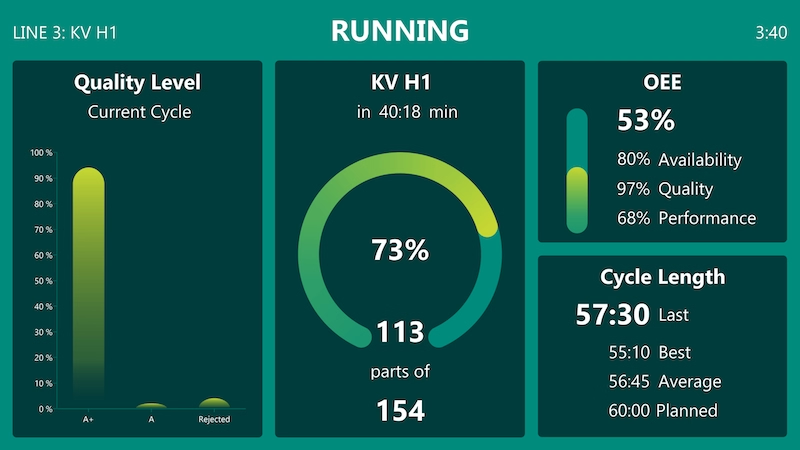
- Machine monitoring tracks machine status, performance and availability in real time and makes stoppages and performance losses instantly visible.
- Unlike an MES or SCADA, machine monitoring is lightweight, fast to introduce and focused on the shop floor.
- Peakboard connects existing machines via PLC, OPC UA or external sensors and shows all metrics on shop floor displays.
- Even mixed machine parks with old and new equipment can be monitored in one system.
Peakboard monitors machine status, cycle times and downtime reasons in real time on the shop floor display – connected directly to the PLC or via OPC UA, without middleware and without an IT project. That is machine monitoring with Peakboard: no status change that goes unnoticed, no stoppage that is only spotted on the next walk-through, no production metric that is only evaluated at month-end.
What is machine monitoring?
Machine monitoring is the continuous, automated capture and display of the operating state of production machines. The goal is to detect stoppages, performance losses and quality deviations early enough to intervene before damage occurs.
Peakboard implements machine monitoring without a long IT project: the connection to the machine controller is configured, not programmed. The first dashboard is live within a few days.
What does machine monitoring track?
A machine monitoring system typically tracks the following signals:
- Machine status: running / idle / fault / set-up / maintenance
- Cycle and takt times: actual cycle time vs. ideal cycle time
- Counter values: parts produced, scrap, good parts per shift
- Fault messages: error codes and alarms from the machine controller
- Process parameters: temperature, pressure, speed (depending on machine type)
- Availability: operating time vs. planned production time
Machine monitoring vs. MES vs. SCADA
Machine monitoring, MES and SCADA are often confused but serve different purposes:
- Machine monitoring: lightweight, shop-floor-focused, fast to introduce. Goal: transparency and speed of response.
- MES (Manufacturing Execution System): full production control including order management, material flow and quality assurance. High implementation effort, often 6–18 months of project time.
- SCADA (Supervisory Control and Data Acquisition): industrial process control technology, mainly for continuous processes (chemicals, energy). Real-time control of plants.
Peakboard positions itself as a complementary layer: it uses the data from existing MES and SCADA, aggregates it and makes it visible on the shop floor – without replacing those systems.
Machine monitoring for older machines
In many manufacturing plants the machine park is mixed: modern CNC systems next to 20-year-old presses without a digital interface. Peakboard supports both worlds: modern machines are connected via OPC UA or S7 direct access. Older equipment can be brought into monitoring via external clamp sensors that measure power consumption. The result: a unified overview of the entire machine park.
Connection to shop floor management
Machine monitoring is the data source for every other shop floor system. The OEE metric is calculated from the monitoring data. Downtime tracking uses the machine signals for stoppage analysis. And the Andon board escalates automatically when a machine status flips. Machine monitoring is therefore not an isolated tool but the foundation of the digital shop floor.
What this looks like as a finished application is shown by two solutions: monitoring cycle time, quality and OEE on a production line covers a single line, and the machine cross-section dashboard shows the status of every operation on the line drawing. How the individual pieces described here come together across a whole machine park – interfaces, displays and long-term evaluation – is set out on our overview of machine monitoring software.
Solution
Cycle Status & Quality
Cycle time, quality level and OEE of a production line live on one screen – with the template ready to download.

What is machine monitoring?
Machine monitoring is the continuous, automated monitoring of machine status, performance and availability in real time – to make stoppages and performance losses instantly visible.
How does machine monitoring differ from an MES?
Machine monitoring is lightweight and shop-floor-focused. An MES covers full production control – including order management, material flow and quality assurance – and requires considerably more implementation effort.
Can older machines without a PLC be monitored?
Yes. Via external clamp sensors that measure power consumption, older equipment without a digital interface can be brought into machine monitoring too.
Which machine states can Peakboard monitor?
Peakboard typically distinguishes RUN (producing), STOP (unplanned stoppage), SETUP (changeover), IDLE and MAINTENANCE – all with timestamp and duration.
How fast does machine monitoring react to a fault?
OPC UA subscriptions deliver state changes in real time – typically within 1 second. The Andon board can escalate immediately, while the machine is still down.
Can Peakboard store and analyse machine data long-term?
Yes. Peakboard writes state changes automatically to a SQL database (data historian). From this, OEE, MTBF and downtime patterns can be analysed over weeks and months.