How to Reduce Machine Downtime: Causes, Costs and Solutions
How machine downtime happens, what it costs, and how Peakboard automatically captures, analyses and reduces downtime.
02.07.2026
·
9 min read
- Unplanned machine downtime costs manufacturers between €500 and several thousand euros per hour, depending on the industry.
- The most common causes are technical faults, missing materials and skipped maintenance – all detectable once machine data is available in real time.
- Peakboard captures downtime automatically from PLC, OPC UA and other sources and reveals patterns before they turn into recurring failures.
- No IT project required: live in a few days, on your existing hardware.
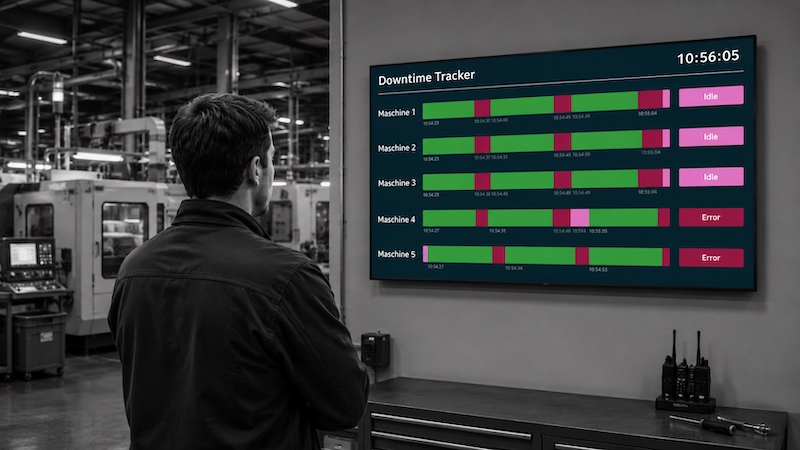
Peakboard captures machine downtime automatically from PLC, OPC UA and ERP – showing in real time which line is stopped, for how long and why, and revealing recurring patterns before they turn into repeated production losses. That is digital downtime tracking: no manual logging, no data lost between shifts, no fault cause left in the dark.
What is machine downtime?
Machine downtime is any unplanned or planned interruption of machine operation. The distinction matters: planned stoppages for maintenance, changeovers or shift changes are predictable. Unplanned stoppages caused by technical faults, material issues or operator errors hit the plant unprepared – and that is exactly where the greatest improvement potential lies.
What does machine downtime cost?
The cost of an unplanned stoppage is made up of several components: lost output, labour costs for waiting staff, express repair costs and possible penalties for late delivery. In the automotive industry, downtime costs of several tens of thousands of euros per hour are reached. In mid-sized manufacturing companies, typical figures range between €500 and €5,000 per hour of downtime – depending on industry, order situation and machine utilisation.
The most common causes of machine downtime
Studies from the manufacturing industry keep showing the same pattern. The most common causes of unplanned downtime are:
- Technical faults: wear, tool breakage, sensor failure or software errors in the controller
- Material shortages: missing raw parts, tools or consumables
- Operator errors: wrong parameters, wrong tool, missing instruction
- Unplanned maintenance: the result of skipped preventive maintenance
- Set-up and changeover times: often written off as unavoidable, but optimisable with data
What these causes have in common: they are all detectable – provided the right data is available at the right time.
Capturing machine downtime automatically
The first step towards reducing downtime is capturing it completely. As long as downtime is logged by hand – on paper or in Excel – inaccuracies, delays and blind spots creep in. Peakboard connects directly to the machine controller (PLC, OPC UA, MQTT) and records every stoppage automatically: timestamp, duration, machine status. The operator can add the fault reason by touch – at the workplace itself, without switching systems.
The result: a complete, audit-proof downtime history without manual transfer errors. The early shift sees straight away what happened overnight – not only after the handover meeting.
Spotting and eliminating downtime patterns
Individual faults are hard to avoid. Recurring patterns are not. Once Peakboard accumulates downtime data over weeks, connections become visible: faults pile up on line 3 every Monday – because the weekend changeover is not documented cleanly. Scrap rises on machine 7 after every shift change – because a setting is not handed over. These patterns were always there. With Peakboard they become visible.
Tracking downtime on older machines
Not every machine on the shop floor has a modern PLC or a digital interface. Older equipment often cannot be connected directly – but that does not mean it has to stay invisible. Peakboard supports connection via external sensors that measure power consumption or vibration signals and derive the machine status from them. A full digitalisation of the machine park is not necessary – even mixed environments of old and new machines can be brought together in one central overview.
Connection to shop floor management
Downtime tracking is not an isolated tool – it is the data source for the entire shop floor system. The captured downtime data flows directly into the shop floor meeting and makes the discussion fact-based. The digital shift log documents every stoppage with context. And a digital Andon board escalates automatically when a threshold is exceeded – while the machine is still down.
What this looks like as a finished application is shown by the downtime tracking solution: every stoppage is recorded with its duration and reason, and MTTR, MTBF and stoppage frequency per machine and shift follow from that record. Stoppages are only one of the signals a machine sends; how they sit alongside status, cycle times and counts on a single board is set out on our overview of machine monitoring software. And how the recorded stoppages turn into availability, and from there into OEE, is shown on our page about OEE software.
Solution
Downtime tracking with Peakboard
Capture machine downtime automatically, analyse causes and spot patterns – on your existing hardware, live in a few days.

What causes machine downtime?
The most common causes are technical faults, material shortages, operator errors and skipped maintenance. Automatic data capture reveals recurring patterns before they turn into repeated failures.
How does Peakboard capture machine downtime?
Peakboard connects directly to the machine controller (PLC, OPC UA, MQTT) and records every stoppage automatically with a timestamp and duration. The operator can add the fault reason by touch.
What does machine downtime cost?
Depending on industry and order situation, between €500 and several thousand euros per hour – including lost output, labour costs and possible penalties.
How long does it take to introduce downtime tracking with Peakboard?
In most plants the first use case goes live within a few days. Peakboard needs no new infrastructure and connects to existing machines on existing hardware.
Can older machines without a PLC be included in downtime tracking?
Yes. External clamp sensors measure power consumption and derive whether a machine is running or stopped. The sensors sit on the outside of the cable and do not intervene in the machine controller.
How does downtime tracking differ from an MES?
Downtime tracking with Peakboard is a lean entry point: fast to implement, no replacement of existing systems, immediate value. A full MES additionally covers order management, quality assurance and material flow.