Production Monitoring: Methods, KPIs and Best Practices
What production monitoring means, which KPIs matter and how Peakboard visualizes production data in real time from machines, PLCs and ERP.
02.07.2026
·
9 min read
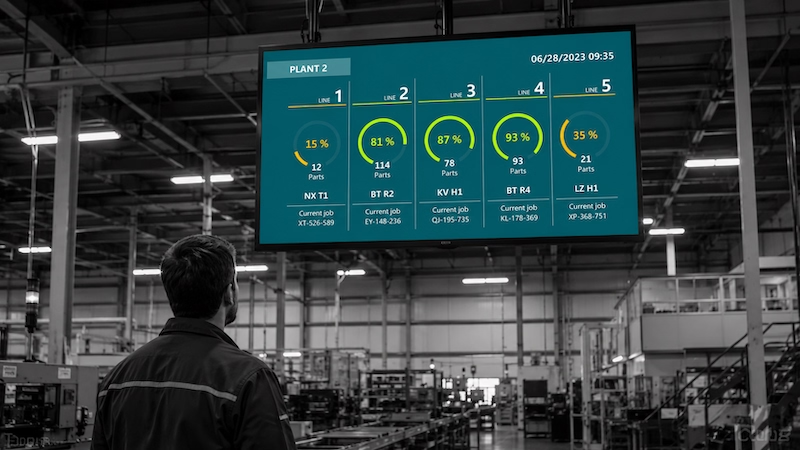
- Production monitoring captures machine status, order data and quality metrics in real time and makes deviations instantly visible.
- The most important KPIs are OEE, throughput, downtime, cycle time and scrap rate.
- Peakboard connects existing machines, PLCs and ERP without an IT project and visualizes all metrics on the shop floor.
- Even older machines without a digital interface can be integrated via external sensors.
Peakboard connects machines, PLCs and ERP in one central dashboard and makes production status, stoppages, OEE and order data visible in real time – so shift leaders and plant management spot deviations before they turn into faults. That is digital production monitoring: no manual gathering of metrics, no gaps between shifts, no reacting instead of steering.
What is production monitoring?
Production monitoring is the systematic capture and visualization of metrics in the running production process. The goal is to keep the actual state transparent at all times and to detect deviations from the target state early. Production monitoring is not a one-off measurement but a continuous, real-time process.
Peakboard enables production monitoring without a big IT project: the platform connects to existing machine controllers (PLC, OPC UA, MQTT), ERP systems (SAP, Dynamics), and quality databases and displays all metrics on shop floor screens.
The most important KPIs in production monitoring
Which metrics you monitor depends on the production type and business goals. The most common KPIs in manufacturing monitoring are:
- OEE (Overall Equipment Effectiveness): Availability × Performance × Quality – the most comprehensive single metric for machine productivity
- Throughput: units produced per time unit, compared with the target
- Downtime: duration and frequency of unplanned stoppages by cause
- Cycle time: actual time per unit compared with the ideal cycle
- Scrap rate: share of defective parts in total production
- Set-up times: time between the end of one order and the production start of the next
Methods of production monitoring
There are different approaches to monitoring production, differing in degree of automation and investment:
- Manual capture: shift leaders enter KPIs on paper or in Excel. Easy to start, but error-prone and delayed.
- MES-based monitoring: full Manufacturing Execution Systems capture all data automatically but require extensive implementation projects.
- Platform-based solution like Peakboard: connects existing data sources without replacing the systems in place. Low implementation effort, live quickly.
Production monitoring on older machines
A common problem in practice: many machines on the floor are more than 10 or 20 years old and have no digital interface. Reading PLC data directly is not possible. For these cases there are two proven routes:
- Power sensors: clamp sensors measure power consumption and derive whether a machine is running, idle, or stopped.
- Manual operator input: the operator enters fault reasons by touch directly on the Peakboard display – no paper form, straight into the system.
Both approaches can be combined and provide a complete monitoring basis even for older machines.
Production monitoring in the shop floor meeting
Production data only reaches its full value once it feeds into the control process. The most important instrument for this is the daily shop floor meeting at the SQCDP board: the current KPIs are discussed as a team, deviations analyzed, and actions created directly in the system. The digital shift log ensures that all events between meetings are documented in an audit-proof way. In case of critical deviations, a digital Andon board triggers immediate escalation.
What this looks like as a finished application is shown by two solutions: Visualize Production Data brings OEE, scrap, and throughput times from single-unit, series, and mixed production together on one dashboard. The multi-line status overview puts several lines side by side and shows the progress of each line down to the individual operation. Where the view starts at the individual machine rather than at the line, our overview of machine monitoring software sets out which signals the machine itself supplies.
Solution
Production data live on the shop floor
OEE, scrap and throughput times from single-unit, series and mixed production on one dashboard – decisions based on data, not gut feeling.

What is production monitoring?
Production monitoring is the real-time capture and visualization of production KPIs such as OEE, throughput, downtime and scrap rate, so deviations can be spotted and corrected immediately.
Which KPIs belong to production monitoring?
The most important KPIs are OEE, throughput, cycle time, downtime, scrap rate and set-up times. Which ones you prioritize depends on production type and business goals.
How does production monitoring work with Peakboard?
Peakboard connects directly to machine controllers (PLC, OPC UA), ERP and other data sources and displays all metrics in real time on shop floor screens – no IT project, on existing hardware.
What is the difference between production monitoring and an MES?
Production monitoring with Peakboard is a lean approach for transparency and fast response. An MES additionally covers order control, material flow and quality assurance. Peakboard can run as a complementary layer on top of an existing MES.
How long does implementation take?
The first use case typically goes live within a few days. Peakboard does not replace existing systems but connects to them.
Can older machines without a PLC be integrated?
Yes – via external clamp sensors that measure power consumption. Even mixed machine parks of old and new equipment can be brought together in a single dashboard.